Worcester Warriors
Should the "Charge Down" be stopped?
By JP
February 22 2021
| Law change discussions had started long before this incident | ||
 |
||
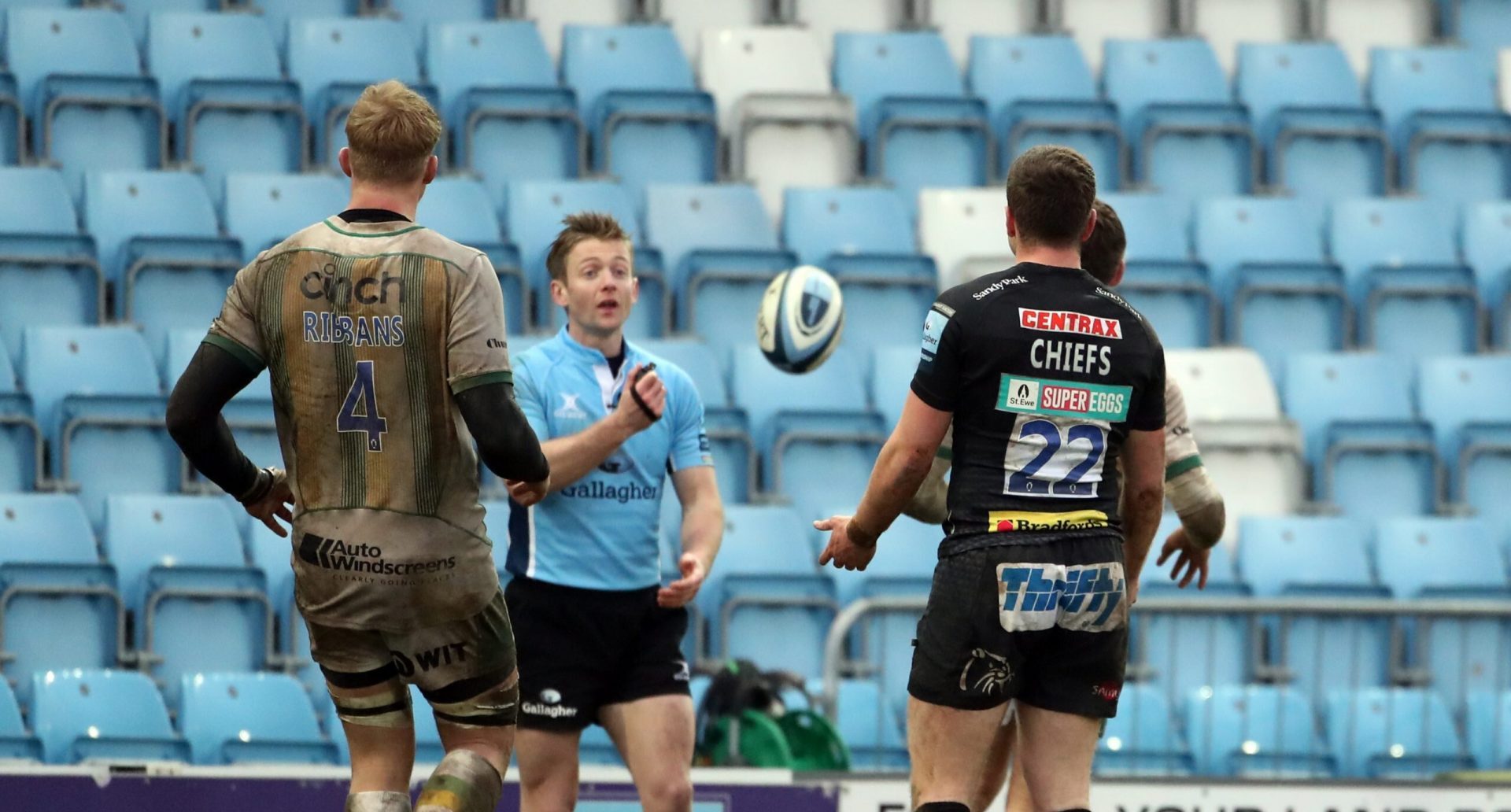
The words ‘movement’ and ‘approach’ have surely never been scrutinised with such forensic detail as following the controversial ending of this weekend’s Gallagher Premiership clash between Exeter and Northampton. With the clock in the red at the end of the toughest of arm-wrestles, Chiefs’ replacement fly-half Joe Simmonds MBE faced a tough match-determining conversion. Across the wind, from a wide-angle and on the harder side for a right-footed kicker, a successful kick won the match for Exeter while a miss left Saints triumphant. Northampton’s Ollie Sleightholme was alert to the possibilities and immediately the home no.10 launched his pre-kick routine with a twitch of the shoulders, the visitors’ winger raced to the ball and when he arrived ahead of a hesitant Simmonds proceeded to kick it into touch. Referee Christophe Ridley, who viewed the entire incident from a perfect position, confirmed the kick had failed and blew the final whistle before clarifying his decision to the home players with the words; “He started his sequence.” |
||
 |
According to Law Eight:
‘All opposing players retire to their goal line and do not overstep that line until the kicker begins the approach to kick. When the kicker does this, they may charge or jump to prevent a goal but must not be physically supported by other players in these actions.’ |
|
Well did or didn't he? He certainly moved his body towards the ball. |
||
|
To most laymen making an approach involves reducing the distance between your starting point and your planned destination – which a shoulder twitch fails to achieve. On this basis Ridley’s interpretation would be incorrect. However, last July’s Super Rugby Aotearoa round five clash between the Crusaders and the Blues raised a similar charge-down query based on the kicker commencing his approach with a backward movement in the long-forgotten style of former British Lions’ skipper Gavin Hastings. This caused NZ Rugby to formally query “What is meant by the phrase approach to kick?” |
|
In response, the sport’s governing body issued a law clarification:
‘The moment the kicker moves in any direction it is deemed that he is ‘approaching to kick.’ The reason for this interpretation is simplicity, otherwise the referee would have to judge when the kicker first moves, and in what direction. It would also be open to misinterpretation by players, match officials and spectators.’ |
Of course, this still fails to deal with the multitude of kickers – most notably including Jonny Wilkinson – whose pre-kick routine involves plenty of movement of the upper body but no movement of the whole body away from or towards the ball. As a consequence, for a second time in as many weeks (following the Jonny May swallow dive controversy during England’s Six Nations win over Italy) World Rugby have been presented with a question that hinges on minute detail. In part this is their own doing, since the last decade has seen multiple attempts to make our sport more accessible by reducing the complexity and size of the law book. As a result, just as the direct instruction ‘a player must not jump into a tackle’ disappeared so did the use of the phrase ‘offers to kick’ in relation to the kicker’s movement towards the ball. |
||
|
The Try Conversion Chargedown |
||
|
This less ‘belt-and-braces’ approach to the law book’s wording requires the team taking charge to interpret the lawmakers’ intentions, which it seems to me is not a step forward. Admittedly, in rugby’s upper echelons this is balanced by the extended use of slo-mo replays and the TMO – but there is an interesting parallel here with football, where the use of VAR for offside rather than sorting out ‘the howler’ has made millimetres significant in decision making, which was never the intention. Law prohibits defending players from doing anything unsportsmanlike to distract the kicker. A number of social media users have cited clearly audible shouting as a reason for the referee to order a re-take of the conversion – but having watched the incident a number of times it seems that this comes from the Northampton bench not the charging players Given the Ridley’s positioning is perfect, he clearly had confidence in his decision. However, given the tightness of the call and the minute detail on which this all hinged, surely a referral to the TMO was appropriate? That said, having watched available footage a number of times I still have doubt since there is not an angle concurrently showing Sleightholme and Simmonds, so this may not have helped.
In summary, We can anticipate further World Rugby clarifications on what constitutes ‘an approach to kick’ in the near future – but instead how about a more radical change which removes the charge-down altogether? Not only would this remove a complication, but in the process speed up the restart since there would no longer be any requirement for defenders to return to the goal-line. |
||

 Digg
Digg Delicious
 Facebook
 Reddit
 Stumbleupon
22/02/2021 10:01
If you do not already have an account Click here to Register.
Edited 1 time(s). Last edit at 2021:03:10:13:06:37 by Faithful_City.
I feel they should keep the charge in.
It gives the defending team a chance/opportunity to save 2 points and possibly win a game, it definitely adds drama.
JP
Surely the shout was bordering on incorrect regardless of coming from beyond the touch line-just as off putting as the charge.
Eats,Shoots And Leaves